Sobeltax — Vehicle Rental Platform
SSR web application for vehicle rentals in Belgium: multi-step booking flow, geolocated agency search, and a full customer dashboard.
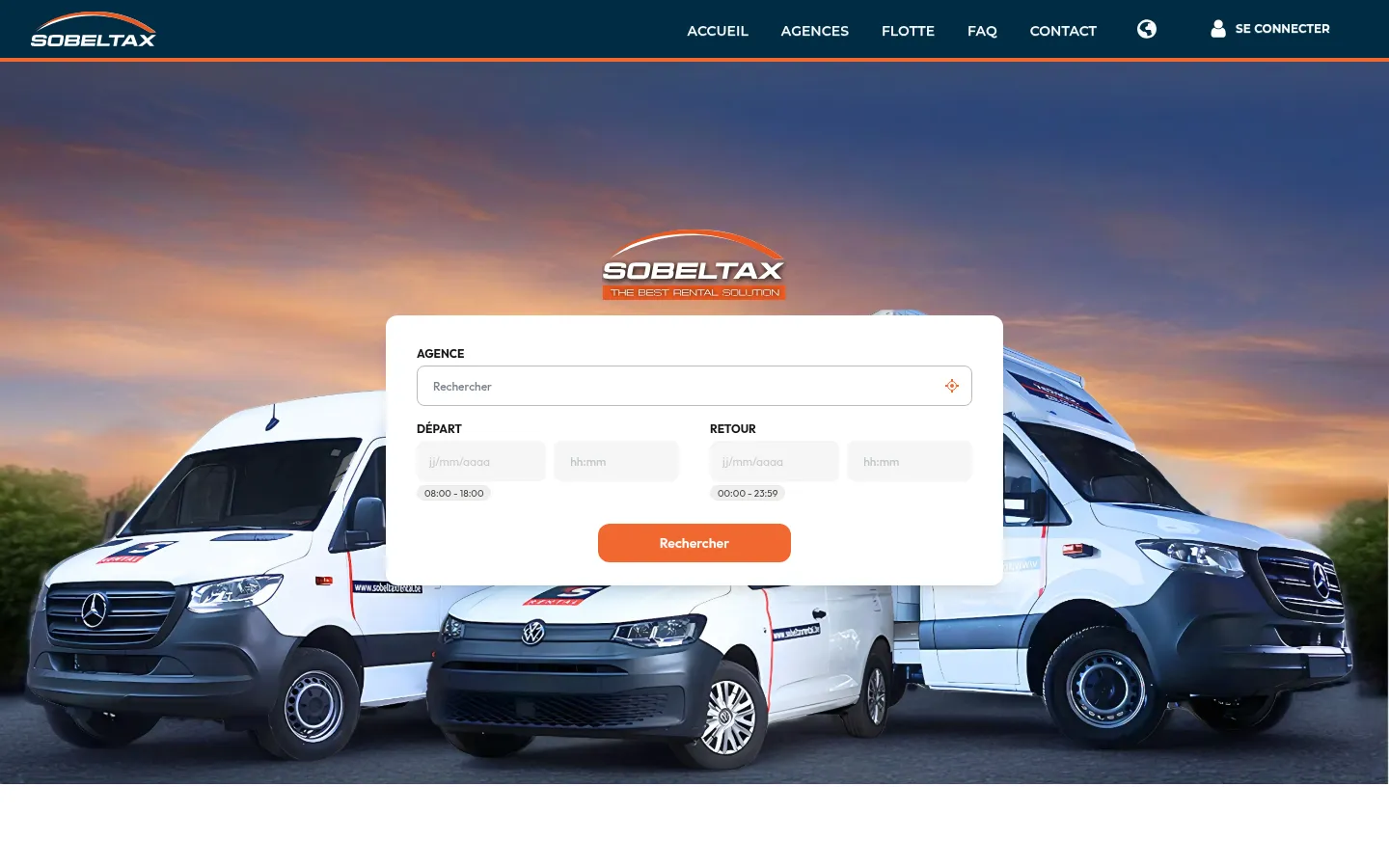
Sobeltax is a vehicle rental platform targeting the Belgian market, available in French, Dutch and English. The challenge was delivering a smooth booking flow, multi-agency management with map-based search, and a full customer area — without relying on a monolithic framework.
The problem
The previous site ran on a legacy stack (WebDev-generated .awp pages): hard to evolve, impossible to align with the brand, and with no real online booking flow. The business data — fleet, availability, agencies, customer accounts — already lived in the internal platform at platform.sobeltaxrental.be. The new site therefore had to be a pure front-end: zero local database, every read and write going through the platform’s API.
Constraints
- No local database. The business platform stays the single source of truth; the site consumes its API for everything: availability, agencies, bookings, the customer area.
- An API that predates the site. It wasn’t designed for this front-end — some data (vehicle families and categories in particular) arrives incomplete and needs client-side mapping.
- Three languages from day one —
fr,nl,en, for the Belgian market. - Delegated authentication: sessions on the site side, tokens refreshed against the platform API through a dedicated middleware.
- Payment via callbacks from an external provider, integrated into the funnel without breaking its state.
Architecture
The application is built with Astro 5 in SSR mode using the Node.js adapter, served by Fastify 5 as the HTTP runtime. Interactive components are Svelte 5 islands: each page ships only the JavaScript for the components it actually uses, with no global bundle. This directly improves Time to Interactive, especially on mobile.
Fastify 5 (server.js)
    │
    ├── Middlewares: CORS, Helmet, static files
    │
    └── Astro SSR runtime
            ├── .astro pages (server-rendered)
            ├── Svelte islands (targeted interactivity)
            └── API routes (actions, payment callbacks)
Redis caches vehicle availability data and agency information to avoid repeated calls to third-party services on every request.
5-Step Booking Flow
The core of the application is a guided reservation process:
- Dates & agency — selection via Pikaday and the OpenLayers map
- Vehicle category — dynamic filtering based on real availability
- Details — driver information, additional options
- Insurance — coverage selection and validation
- Confirmation — summary and payment trigger
The booking state is persisted client-side with Nanostores, so users can navigate between steps without losing entered data, even after a page reload.

Geolocated Agency Search
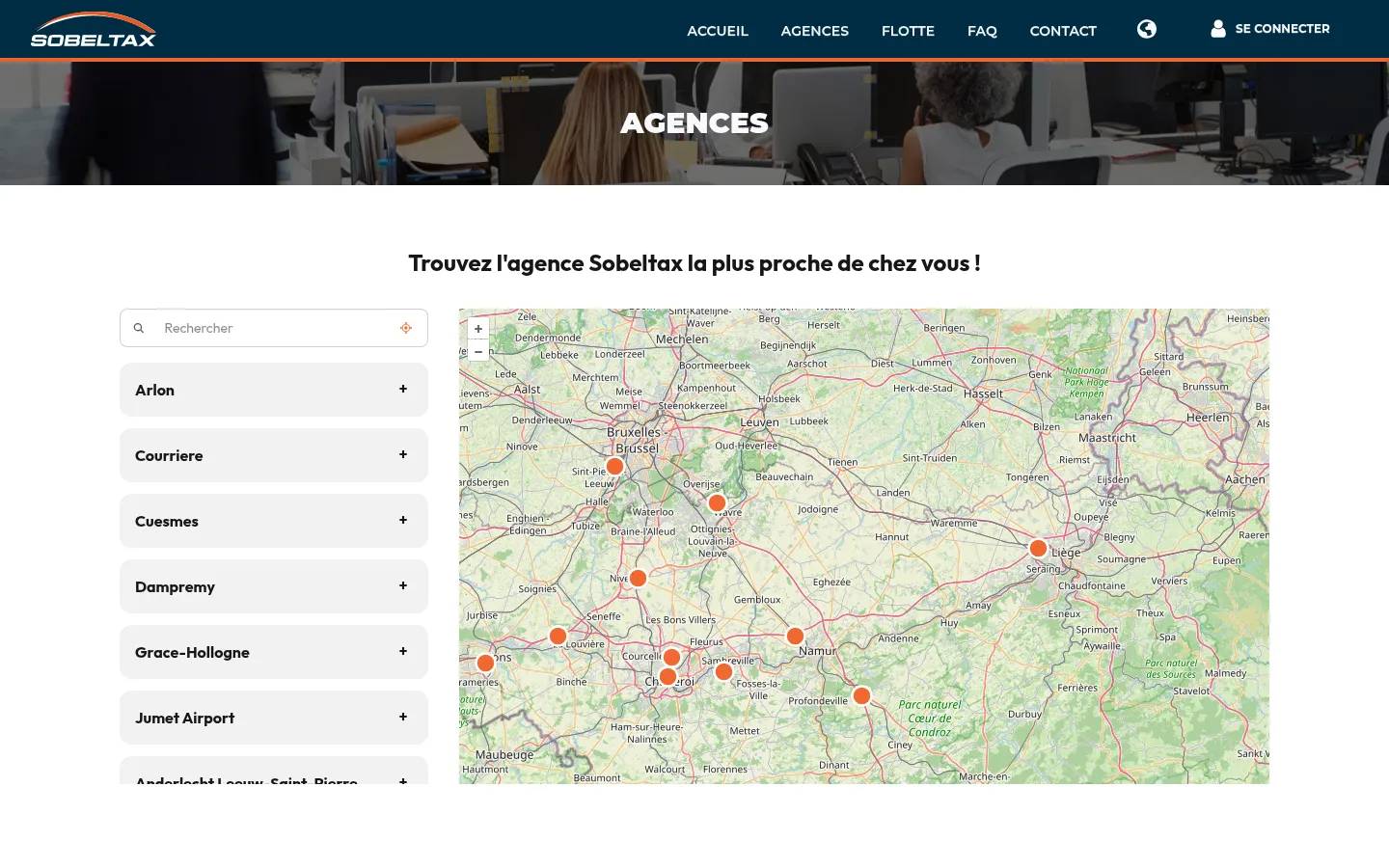
The agencies page integrates OpenLayers 10 to display the network on an interactive map. Search works by name or address; the agency list synchronises with the map state in real time. OpenLayers was chosen as an open source alternative to Google Maps — no quota, no API cost.
Belgian Multi-Language
i18n routing follows the Astro pattern: / for French (default locale, no prefix), /nl/ and /en/ for Dutch and English. The fr-BE and nl-BE locales are declared in the sitemap and meta tags for date and currency formats adapted to the local market.
Deployment
The application runs on Docker Swarm with a dedicated production Compose file. The Fastify server listens on port 3000 behind a reverse proxy. A multi-stage build separates dev dependencies from production artefacts, keeping the final image lean.
What it shipped with
- 66 pages and 53 components, across 3 locales
- 5-step booking funnel, full customer area, 14 mapped agencies, 10 vehicle families
- Around 560 commits over 17 months (January 2025 → May 2026) — the project is in production and still actively maintained
- Redis sessions with a 7-day TTL, server-side availability caching
Lessons
- An API you don’t control gets coded defensively. Token refresh produced its share of edge cases, and the API’s incomplete data forced a hardcoded vehicle-category mapping on the front-end — a workable trade-off, but one that has to be maintained every time the fleet changes.
- Validate early, against real cases. Belgian VAT number validation generated several after-the-fact fixes; realistic test data from the start would have been cheaper.
- Redis between the SSR and the API changes everything. The availability cache keeps pages fast even when the upstream platform is slow — on an SSR site backed by a third-party API, that’s the difference between a snappy site and one that inherits everyone else’s latency.
Related work