Listify — Real-Time Collaborative Lists
Real-time collaborative lists and kanban app built on Elixir/Phoenix/Ash: live sync, roles and invitations, optimistic locking, LexoRank ordering, and GDPR compliance.
Listify is a real-time collaborative lists and kanban app: several people edit the same lists, see changes appear instantly, and manage members, roles and notifications. A greenfield project driven by a detailed specification, in production and self-hosted.
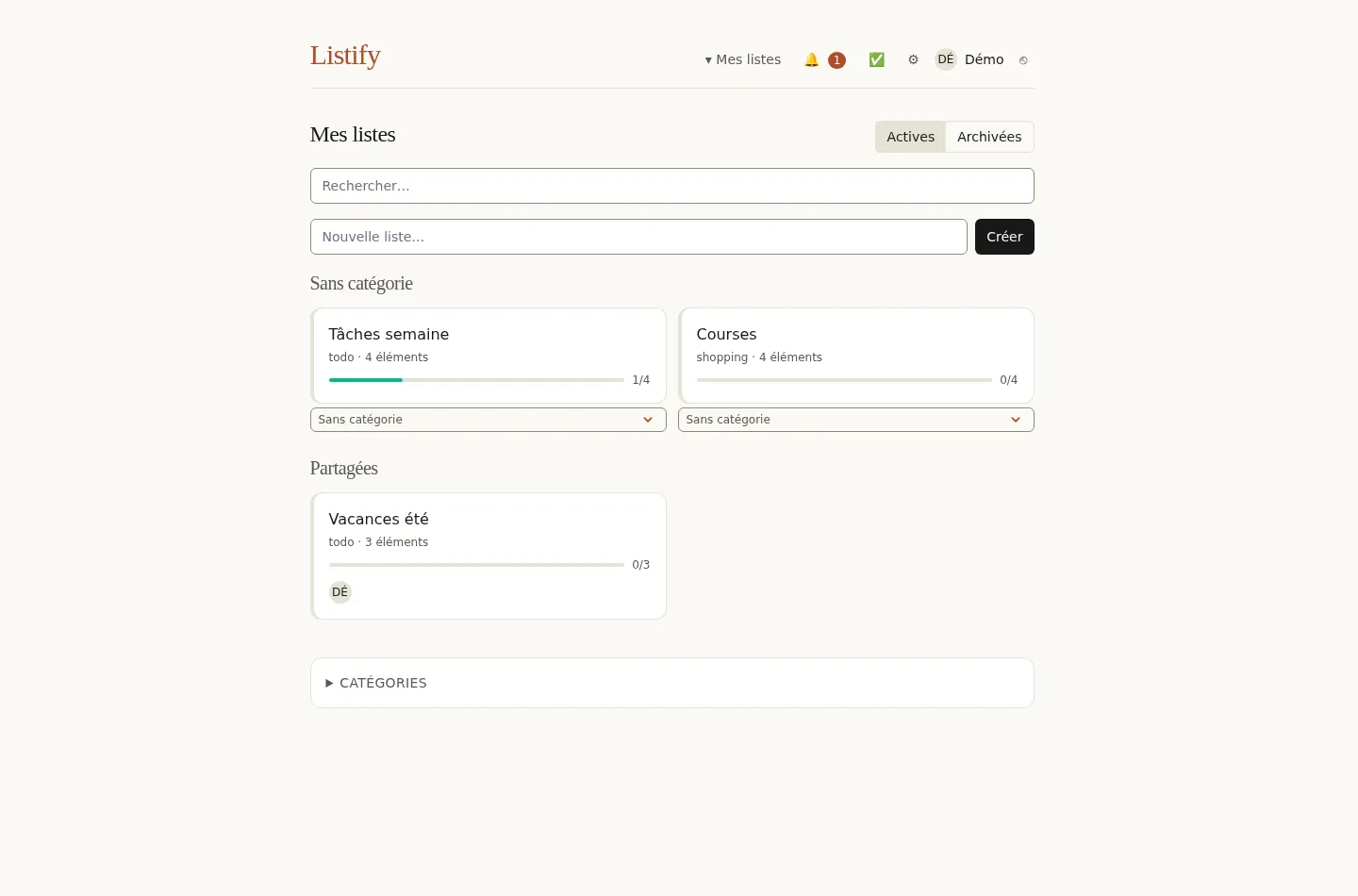
The problem
I wanted a real testbed to push the Elixir/Phoenix/Ash stack on a non-trivial domain: real-time collaboration. Not a demo to-do list, but a complete app — edit concurrency, roles, invitations, notifications, audit, GDPR — driven by a spec written before the code, to lock the architecture decisions up front rather than improvising them.
Constraints
- Real-time multi-user with no lost conflicts and no stale payloads.
- Architecture decisions frozen at the spec (v1.3/v1.4, numbered sections): ordering, locking, job-queue topology.
- Self-hosting: everything has to fit in a Docker Swarm deployment with no third-party managed service.
- GDPR compliance from the start (data export, account deletion).
Architecture
The app is 100% Phoenix LiveView — no SPA framework, interactivity is server-driven over WebSocket. Business logic, persistence and authorization all go through Ash 3.4 (AshPostgres), organised into domains: Accounts, Lists, Messaging, Notifications, Audit, Backups, Moderation.
Phoenix LiveView (server-driven UI)
    │
    ├── Ash domains (logic, authorization, persistence)
    │      Accounts · Lists · Messaging · Notifications · Audit · Backups
    ├── Phoenix PubSub (real-time signalling)
    ├── Oban (jobs: mailer, exports, scheduled, critical)
    └── PostgreSQL 16 + Redis (sessions)
Real-time: signalling, not payload
Every item or list mutation publishes a message to a PubSub topic (items:list:<id>). But the key point: the LiveView does not consume the broadcast payload — it receives a plain signal ({:item_updated, id}) and re-reads the full resource through Ash, with authorization and policies applied. PubSub is a signalling mechanism, not a data transport — which eliminates the entire class of “stale payload” bugs.
Selective optimistic locking
Concurrent item edits are guarded by a lock_version checked atomically in the SQL WHERE clause (not after fetch — so no race). A conflict returns a 409 with the server’s version so the client can re-fetch. But only the “heavy” fields (title, description, labels) are guarded; hot fields (status, rank, assignment) go through separate last-write-wins actions to stay fast. This isn’t pessimistic locking — it’s targeted conflict detection.
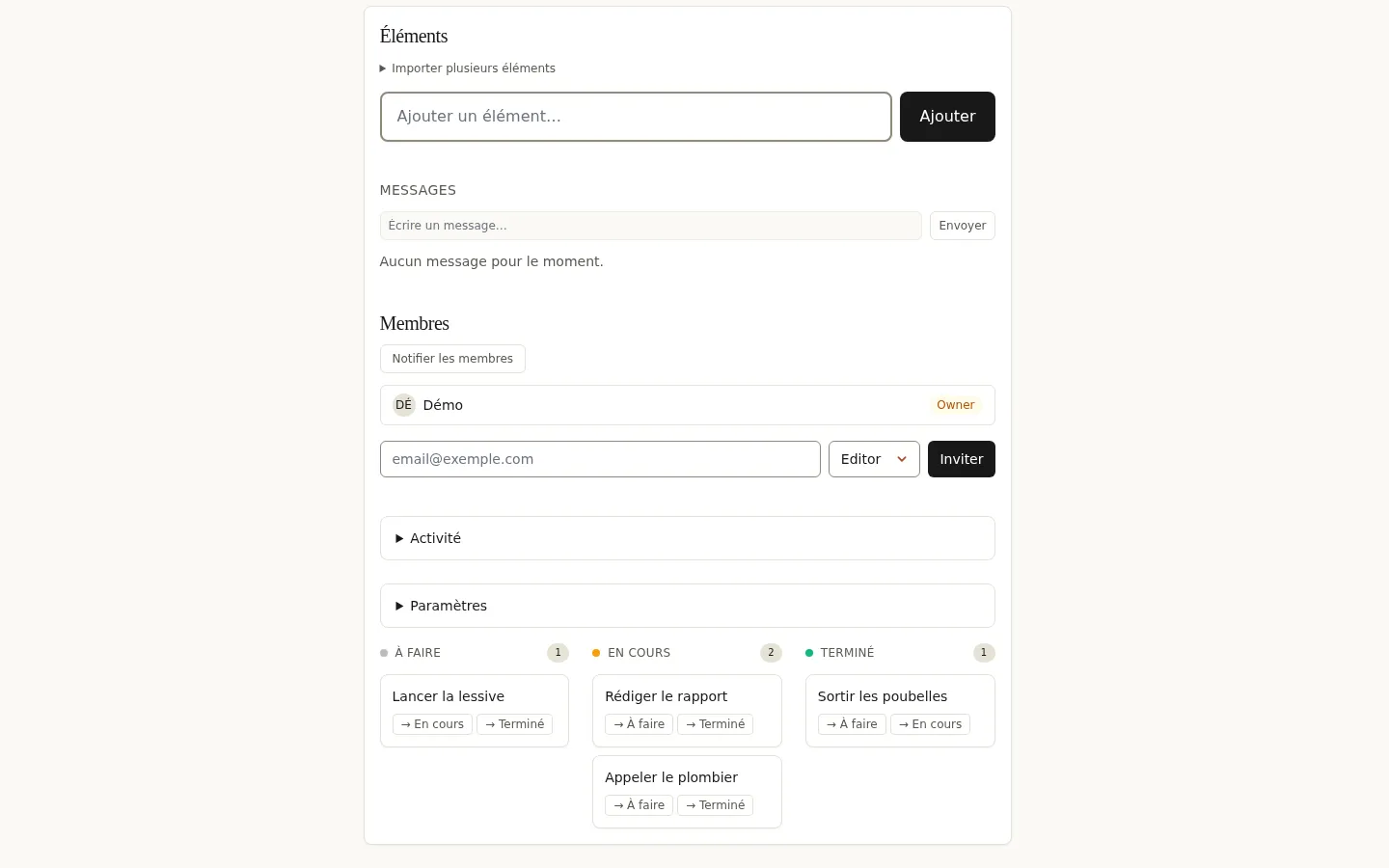
LexoRank ordering
Item ordering uses LexoRank (rank strings) rather than integer positions: reordering inserts a rank between two neighbours in O(1), never renumbering or locking a global sequence. Two concurrent reorders don’t coordinate — the bit-string math guarantees monotonicity.
Background jobs (Oban)
Queue topology fixed in the spec: default (10), mailer (5), exports (3), scheduled (2), critical (1). Around fifteen workers: invitation and mention mailers, due-date reminders, daily digest, recurring-list resets, GDPR export, deferred account purge, S3 backup cleanup.
What it shipped with
- 33 days, 185 commits — in production at
listify.josephpire.dev(Docker Swarm, 2 replicas, rolling updates) - Auth (AshAuthentication + bcrypt + magic links), real-time lists/items, owner/editor/viewer roles, invitations
- Notifications (bell + toast), append-only audit log, CSV export, REST API + OpenAPI/Swagger docs
- GDPR: data export and account deletion with a grace period; Web Push (PWA); S3 backups
Lessons
- A spec written before the code locks in the right decisions. LexoRank ordering, locking strategy, Oban topology: decided once, never re-litigated mid-build.
- PubSub as a signal, not a transport. Broadcasting an id and re-reading behind the authorization layer is one DB round-trip slower, but it removes data leaks and stale payloads — a trade-off worth making.
- Ash rewards rigor. Modelling authorization in the resources rather than the views takes discipline up front, then every new surface (REST API, LiveView) inherits it for free.
Related work