Holmes — Analytics Microservice
Go event-tracking microservice: per-client, per-action hit recording, monthly aggregation, and session-protected admin and customer dashboards.
Holmes is the in-house analytics service for the Tech Cards NFC card platform. It exposes a public POST /api/hits/:client_id/:action_id endpoint consumed by every card page to track views and clicks on links or badges — no cookies, no third-party scripts.
Architecture
The application is written entirely in Go 1.23. The structure follows a classic layered design, wired together by dependency injection via Uber fx.
main.go  (fx.New → DI container)
    │
    ├── Config      (Viper — app.env + cors.yaml)
    ├── Database    (GORM + SQLite)
    ├── Service     (business logic)
    ├── Middleware  (session auth: admin / customer)
    └── Handler     (Echo routes)
HTML templates are generated with Templ — a compiler that turns .templ files into typed Go functions, with no string concatenation and no html/template at runtime.
Hit Tracking
The core of the service is a minimal upsert:
UPDATE Views SET Count = Count + 1 WHERE client_id = ? AND action_id = ? AND month = ? AND year = ?- If
RowsAffected == 0,INSERTa new row withCount = 1
Each entry is scoped to (client_id, action_id, month, year). Read queries aggregate with SUM(Count) GROUP BY client_id, action_id to consolidate totals over a period.
Dashboard
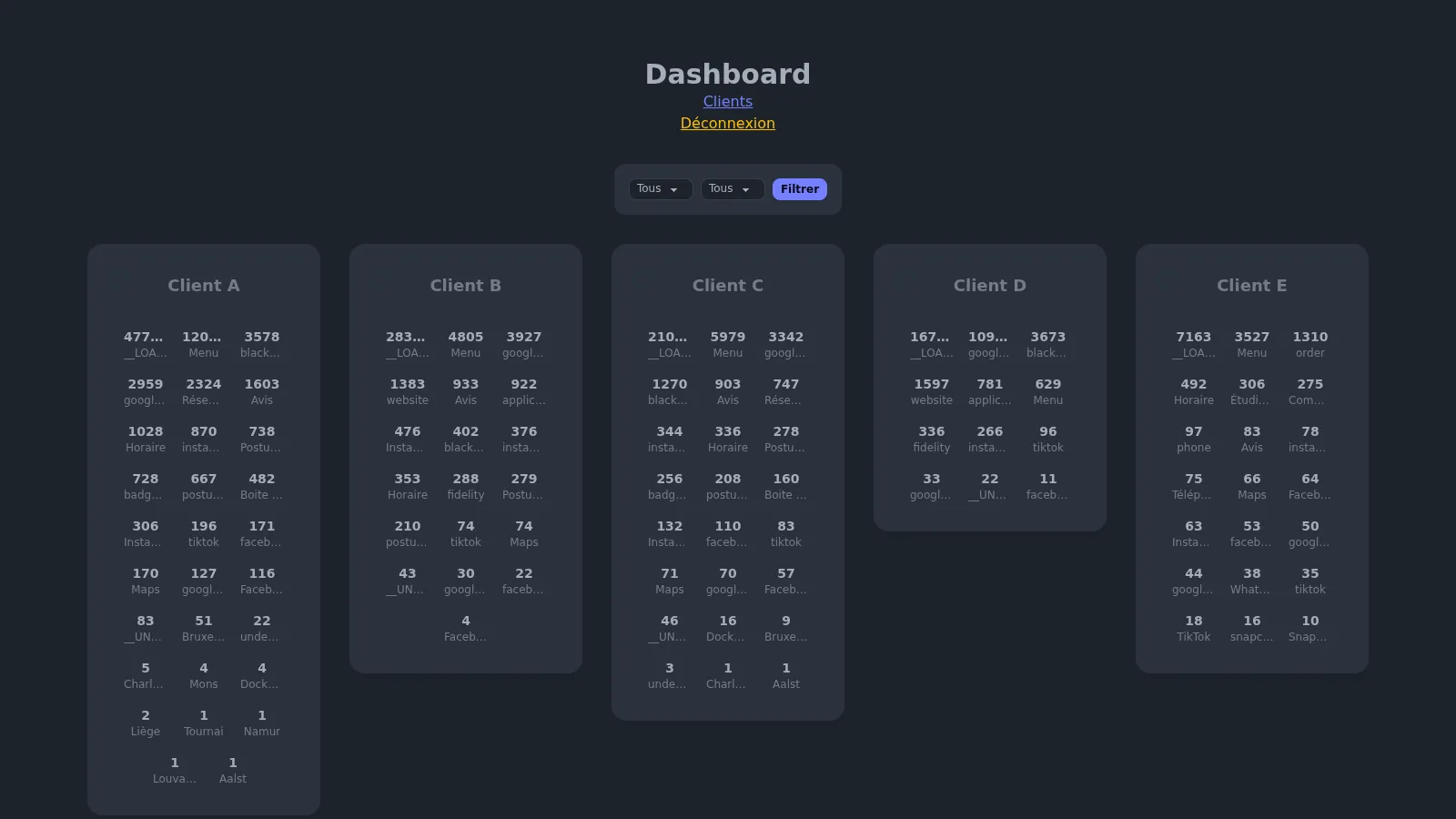
Two access levels protected by Gorilla Sessions:
- Admin — global view across all clients, sorted by descending hit volume
- Customer — view restricted to the slugs linked to the logged-in account
The month/year filter in the dashboard is an htmx-boosted form: partial reloading avoids a full-page refresh without adding custom JavaScript.
Configuration
Allowed CORS origins are declared in config/cors.yaml, hot-reloaded via Viper + fsnotify. Secrets (admin password, cookie key) are injected from an app.env file at startup, with an explicit panic if COOKIE_SECRET is missing.
Deployment
The Docker image runs on the same Swarm network as Tech Cards, behind Caddy (holmes.nsmobile.be). The SQLite database is persisted in a bind-mounted ./database volume. A GitHub Actions pipeline builds and deploys the image automatically on every push to the main branch.
Related work